Philosophy
Peace through predictability — why the Fleet path is ETA-first, how the Shop fits in, and what Delieta deliberately does not build.
Delieta exists because local businesses in Poland still tell the customer “we’ll be there in an hour and a half” and leave it at that. The big apps have long given customers that certainty: you see the car, you see a time window, you can go walk the dog. We want to give the same to the pizzeria around the corner, the florist and the technician who fixes leaks.
Delieta today has two paths: Fleet and Shop. Fleet is built on ETA, the estimated time of delivery. The Shop is about selling, before anything moves.
The name DeliETA means delivery of the estimated time of delivery. The repetition is deliberate: the industry talks about “ETA” all the time and almost never gives it to the person who is waiting.
Peace through predictability
This is our main principle. The product’s job is to remove people’s constant worry. The customer stops wondering. The owner stops answering phone calls asking “where is my order”. The driver stops being a go-between for one side and the other.
We judge every screen by this principle, on both paths. A screen that causes worry through clutter, too much information or apparent accuracy to the minute is bad, even when it is pretty. The ETA window exists because a specific minute turns out wrong sooner than a range.
Fleet is built on ETA
A time window concerns delivery, so it concerns the Fleet path: the driver’s position, the tracking page and the quote from the API. In the Shop the same idea looks different: the customer knows what they ordered, what it costs, when it will be ready and whether they paid. When a company turns Fleet off, there is no ETA window and we do not pretend there is: the tracking page shows the status alone. Apparent accuracy is worse than no number.
A benefit for three sides
Delieta helps three people at once. The owner sees who is on the road and what is at risk, instead of relying on phone calls and gut feeling. The customer sees a map, the driver moving and a certain time window, without installing anything. The driver gets a work tool, not a surveillance tool: they accept a run, drive, and report when something is wrong.
If we helped only one side, we would be a feature inside someone else’s product. With three sides it becomes a platform that companies come to for predictability, not just for handling a basket.
What Delieta is not
We are not a general logistics platform competing with corporate TMS systems. We are not just a tracking widget added to someone else’s system: handling orders, sales, fleet and alerts is also part of what we promise. We are not a marketplace: we do not gather restaurants for people who order dinner from us. We are not a bank: online payments go through Stripe Connect to the company’s account, and Delieta connects the shop to the payment and shows the balance, payouts and disputes.
The person who receives the pizza does not sign a contract with us. They open their pizzeria’s shop or link. Because of this distinction we are the company’s tool, not a go-between for it and its customer.
Effects that add to the worry
We deliberately do not build three-dimensional globes, drone views of the fleet or elaborate entrance animations. Such effects draw attention away from what is meant to reassure, which is the ETA. The tracking page has a big time window, a map and a status. The marketing page is meant to build trust and persuade, not to show off effects. An animation that gives the customer no certainty is only a cost.
For the same reason we avoid apparent accuracy. If the system promises a specific minute and then changes it, the customer learns that Delieta lies. A range that narrows when the signal is sure teaches the opposite.
We do not build a marketplace
A marketplace might look like a growth opportunity, but it would pull us away from predictability. Delieta is a local business’s tool, not a site where a hungry person compares three pizzerias. Gathering consumers in one place would set us against the customer whose peace we protect, and against the company that pays us.
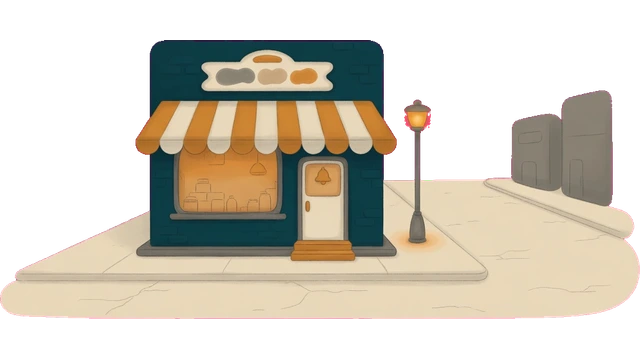
That is why the shop is that company’s shop: under their brand, with their menu, their prices and their customers. Delieta provides the back end — orders, payments, reservations, catering — and the contract through which a storefront reads it. We do not stand between the company and its guest.
What is missing today — and why
Missing is what the product’s main work cycle does not need: the shop takes an order → the driver moves → the customer sees that they move → the owner sees what is going on. Everything that serves that cycle is already there. The rest is the temptation to build too much.
These are not there today:
- A delivery-confirmation photo. The driver reports a delivery, but without a photo of the handover.
- Kitchen and table screens. The order queue waits in the panel, not on a separate display.
- A learning-model ETA. We compute the window from the route (or from the straight line when there is no route) and a buffer, not from a prediction. See ETA window.
- A position without the driver’s phone. GPS comes from the Driver app on the phone, not from a device wired into the car.
- A consumer marketplace. See above.
We already have these, though they used to be missing: a custom tracking domain (Pro plan), online payments through Stripe Connect, ingredients with stock levels, reservations, catering and shop translations. Modules and subscription describes them.
We do not publish a list here of matters we have not decided yet. This page is about why we say no, not about what may come back next quarter.
From one feature to the whole
We are counting on something simple. Once a local business starts using Delieta for one thing, selling or tracking, the other modules turn out clearly more convenient than three separate vendors. Predictability brings the company in, and a coherent system keeps it. A product that promises both from day one usually delivers neither.
That is why this documentation starts from sending a link and creating an order, not from a description of the platform. A platform you cannot use on a Friday evening is of no use.